

Workflows
Workflows connect triggers to actions, with optional conditions to control when automation runs. They handle the core of user lifecycle management, from onboarding to offboarding.
Important: Workflows are only triggered by Adcyma's user management actions: creating new users, editing existing users, or removing users (including via API and CSV import). If no conditions are specified, the workflow will run for all users matching the trigger.
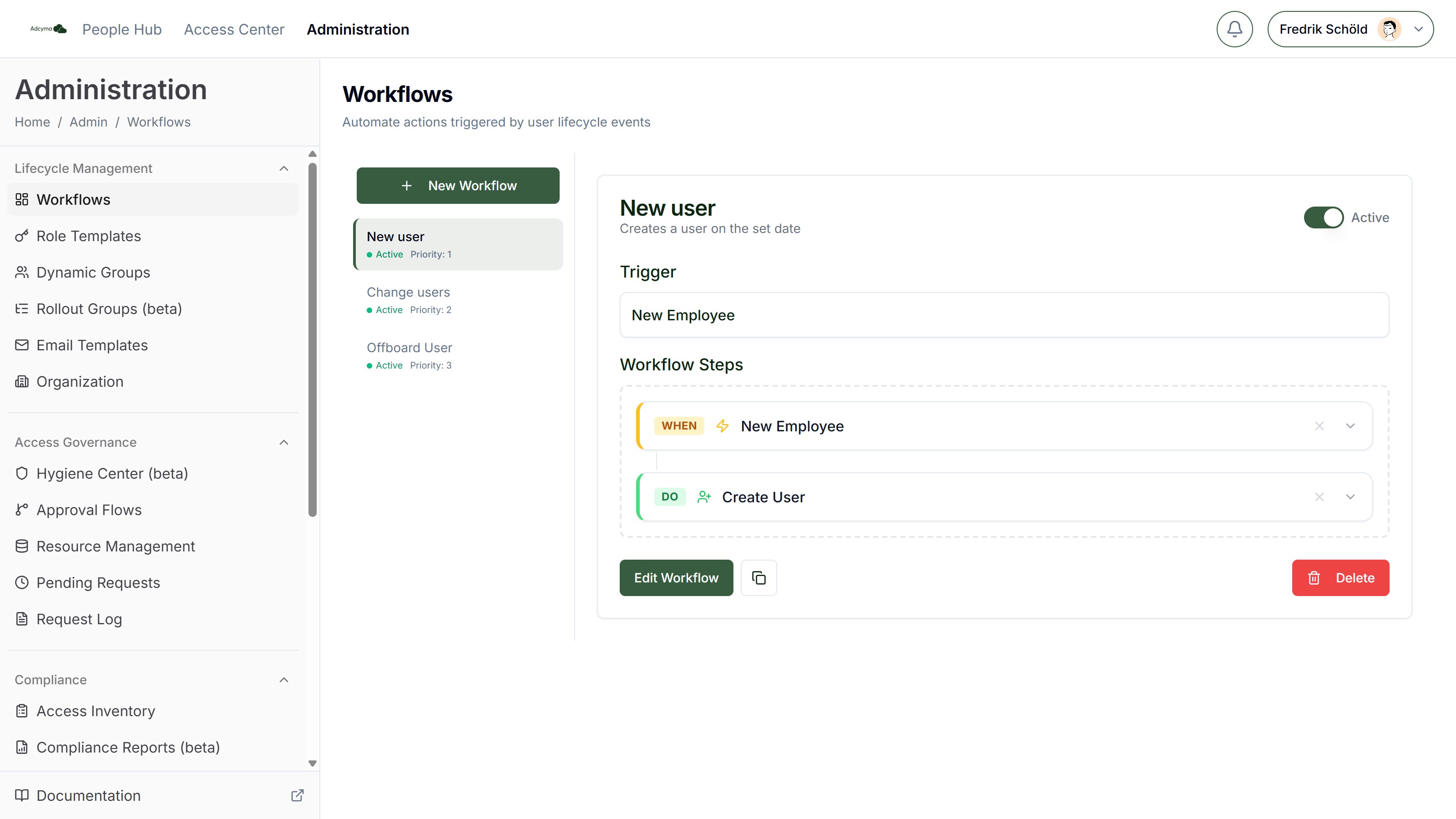
Page Layout
The Workflows page has a sidebar listing all your workflows. Each entry shows the workflow's name, whether it is Active or Inactive, and its priority. A search box appears once you have more than a few workflows. Selecting a workflow shows its trigger and a visual flowchart of its steps: WHEN blocks for the trigger and conditions, and DO blocks for each action.
Workflow Components
Basic Settings
Workflow Name
- Descriptive identifier for your workflow
- Does not need to be unique, but should clearly indicate the workflow's purpose
Priority
- Determines execution order when multiple workflows match the same trigger and conditions
- Lower numbers = higher priority (1 is highest priority)
- Controls which workflow runs first in overlapping scenarios
Description
- Optional field for detailed workflow documentation
- Helps team members understand the workflow's purpose and logic
Automation Logic
The trigger defines which user management event starts the workflow (user created, modified, or removed).
The condition is an optional filter based on user attributes. If no conditions are set, the workflow applies to all users matching the trigger. Examples: users in specific departments, managers only, users reporting to certain supervisors.
The action is what the workflow actually does when trigger and conditions are met. You can chain multiple actions in sequence. Examples: assign role templates, send emails, enable accounts, update user attributes.
Each action can have an optional delay. Set a delay value and unit (hours, days, or weeks) to schedule the action to run after a waiting period instead of immediately.
Directory-Aware Actions
If your tenant runs in Hybrid mode (Active Directory + Entra ID), the workflow editor lets you choose which directory user creation actions target: Active Directory, Entra ID, or your company default. See Identity Provider for how directory modes are configured.
Workflow Management
Active/Inactive
- You can deactivate workflows without deleting them using the toggle in the workflow header
- Useful for testing, maintenance, or seasonal processes
- Inactive workflows keep all their configuration but won't execute
Duplicate
- Copy an existing workflow to create a similar one with modifications
- Duplicates are saved as inactive so they never fire before you have reviewed them
Delete
- Permanently removes a workflow after a confirmation prompt
Example Workflow Scenarios
New Employee Onboarding
- Trigger: User Created
- Condition: Department = "Sales"
- Actions: Assign sales role template, send welcome email, enable account
Manager Promotion
- Trigger: User Modified
- Condition: Job Title contains "Manager"
- Actions: Add to management groups, send notification to IT, update permissions
Department Transfer
- Trigger: User Modified
- Condition: Department changed
- Actions: Remove old department access, assign new department role, notify managers
How Workflows Execute
- Someone creates, edits, or removes a user in Adcyma (or via API or CSV import)
- The system checks which workflows match the event type
- If conditions exist, it verifies the user meets the criteria
- Multiple matching workflows run in priority order (lowest number first)
- Each workflow performs its defined actions
Best Practices
- Make workflow names obvious so your team can tell what each one does at a glance.
- Set priorities so that critical workflows run before optional ones.
- Test conditions carefully. Remember that no conditions means "all users."
- Use the description field for workflows with multiple conditions.
- Review workflow results periodically to make sure they're working as expected.